

Innovation
BIOUAV: Intelligent Environmental Monitoring System
In a context where climate change, the spread of invasive species, and increasing pressure on ecosystems make a faster, more integrated, and predictive environmental monitoring system essential, BIOUAV is the intelligent solution developed by nesea that integrates multispectral drones, a cloud platform, and Artificial Intelligence to transform environmental data into concrete operational decisions.
Advanced features of the BIOUAV environmental monitoring system
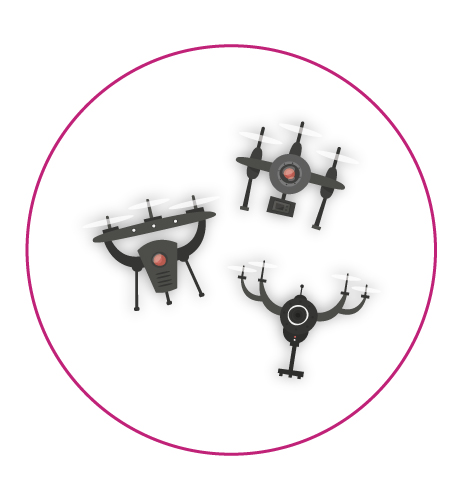
The BIOUAV environmental monitoring system integrates autonomous drones, multispectral sensors, a cloud platform, and Artificial Intelligence algorithms to offer a complete infrastructure for the acquisition, analysis, and interpretation of environmental data.
The combination of UAV technology, multispectral analysis, and AI transforms raw imagery into georeferenced maps and operational insights, enabling continuous, predictive, and non-invasive environmental monitoring.
 Advanced performance analysis
Analytics tools transform operational data into actionable insights to identify inefficiencies, analyze consumption, and support data-driven decisions.
Advanced performance analysis
Analytics tools transform operational data into actionable insights to identify inefficiencies, analyze consumption, and support data-driven decisions. Automated processing with AI
AI algorithms analyze images to identify invasive species, vegetation anomalies, and ecosystem changes quickly and predictively.
Automated processing with AI
AI algorithms analyze images to identify invasive species, vegetation anomalies, and ecosystem changes quickly and predictively. Georeferenced maps and environmental insights
The system generates thematic maps that locate critical areas and support targeted interventions on the territory.
Georeferenced maps and environmental insights
The system generates thematic maps that locate critical areas and support targeted interventions on the territory. Scalable and multi-sector architecture
A modular and replicable solution, applicable in agricultural, forestry, urban and industrial sectors.
Scalable and multi-sector architecture
A modular and replicable solution, applicable in agricultural, forestry, urban and industrial sectors.Concrete benefits of the BIOUAV environmental monitoring system
BIOUAV is not just a technology, but an environmental monitoring system that generates measurable value for public bodies, companies, and territories, improving sustainability, decision-making capacity, and environmental risk management.
Faster and more accurate environmental monitoring
It dramatically reduces data collection and analysis times, ensuring early identification of invasive species and critical areas with greater scientific precision.
Data-driven decision support
It transforms multispectral imagery into georeferenced insights, allowing institutions and companies to plan targeted interventions based on objective and up-to-date data.
Reducing operational and environmental impact
Thanks to fully electric drones and non-invasive monitoring, it limits movements, emissions, and interference with natural ecosystems.
Improving ESG performance
It supports sustainability strategies and environmental reporting, contributing to the protection of biodiversity and responsible land management.

Discover our smart solutions
By integrating advanced technologies, our Smart Solutions transform and personalize user experiences to define new standards in digital interaction.



 English
  Italiano